
 Photo: Mike McBey, CC BY 2.0
Phoenix Sky Harbor is the largest airport in Arizona and, for many travellers, the gateway to the Grand Canyon. The South Rim is about four hours north by car, and the drive climbs from the Sonoran Desert to the pine forests around Flagstaff. There are two classic routes, the direct one on I-17 through Flagstaff and a slower one through Sedona and Oak Creek Canyon, and a couple of variations that make sense depending on where you sleep. This guide compares them, with the stops on the way, the shuttle option and where to stay.
Distances and times come from the sources listed at the end, as of October 2026, and exclude stops.
The short answer
- Phoenix to the South Rim is about 225 miles (362 km) and four hours on I-17 and US-180 via Flagstaff, according to James Kaiser; the National Park Service also gives about four hours.
- Via Sedona adds about 30 minutes of driving, by Kaiser's estimate, and much more once you add stops.
- Montezuma Castle, right off I-17 about 90 minutes from Phoenix, is the easiest stop on the way.
- Without a car, Groome Transportation runs shuttles from the airport to Flagstaff and on to the South Rim, with a change in Flagstaff.
- Fees: since 1 January 2026, visitors who are not US residents pay $100 each, aged 16 and over, on top of the $35 vehicle pass. See Grand Canyon entrance fees in 2026.
The routes at a glance
| Route | Roads | Time without stops | Best for |
|---|---|---|---|
| Direct, via Flagstaff | I-17 north, then US-180 via Valle | about 4 hours, about 225 miles (362 km) | getting there; a night in Flagstaff |
| Via Sedona | I-17, SR-179 to Sedona, SR-89A through Oak Creek Canyon to Flagstaff, then US-180 | about 4.5 hours | a day with stops, or a night in Sedona |
| Via Williams | I-17 to Flagstaff, I-40 west to Williams, AZ-64 north | Williams to the rim is about 1 hour | the Grand Canyon Railway, Route 66 |
| Via Cameron and Desert View | I-17 to Flagstaff, US-89 north to Cameron, AZ-64 west | the last leg is 25 miles (40 km) to the East Entrance | entering from the east along Desert View Drive |
Sources: James Kaiser (direct route and the Sedona detour), National Park Service (Williams and Desert View legs).
Leaving Phoenix: I-17 north
I-17 starts in Phoenix and runs north to Flagstaff. The first part is desert; the road stays at about 3,500 ft (1,070 m) until Cordes Junction and reaches 6,500 ft (1,980 m) at Munds Park, according to AARoads. About 100 miles (160 km) out of Phoenix, Kaiser notes, the road climbs the Mogollon Rim and the desert gives way to ponderosa pine.
The interstate is the main road between the Phoenix area and the north, and it is busiest at weekends and on holiday weekends. To ease that, the Arizona Department of Transportation added about 8 miles (13 km) of reversible flex lanes between Black Canyon City and Sunset Point, which first opened in 2025. According to KJZZ, they carry northbound traffic from Friday to Saturday and southbound traffic from Sunday to Monday. If you have a choice, leave Phoenix early on a weekday morning.
Sunset Point, at exit 252, is a rest area with a view over Black Canyon and a natural first stop.
Montezuma Castle: the stop that fits any plan
Montezuma Castle National Monument is at exit 289 of I-17, about 90 minutes north of Phoenix and 45 minutes south of Flagstaff, according to the National Park Service. The castle is a five-storey, 20-room dwelling built by the Sinagua people into an alcove about 90 ft (27 m) up a limestone cliff. You see it from below, from a short trail of about a third of a mile (540 m). It was one of the first national monuments, established in 1906.
As of October 2026:
- Entry is $10 per adult aged 16 and over, valid for seven days at both Montezuma Castle and Tuzigoot National Monument; under-16s are free. The park lists no separate nonresident fee, and the America the Beautiful pass is accepted.
- Montezuma Well, part of the same monument, is free. It is at exit 293, then about 4 miles (6 km) on local roads; the park says it is a 20-minute drive from the castle.
- Use the paved roads. The park warns that GPS can send drivers onto rough backcountry roads between the sites.
Roughly an hour is enough for the castle; add another if you also want the Well.
The direct route via Flagstaff
From Montezuma Castle, I-17 climbs to Flagstaff, the largest town in northern Arizona. From there US-180 runs north-west through the forest and joins AZ-64 at Valle for the last stretch to the South Entrance: about 79 miles (127 km) and an hour and a half from Flagstaff, according to the National Park Service and James Kaiser.
This is the fastest way in and suits a night in Flagstaff on the way, with its Route 66 downtown, Lowell Observatory and wide choice of restaurants. In winter, check road conditions with the Arizona Department of Transportation before setting off over the high country.
The scenic route via Sedona and Oak Creek Canyon
Sedona's red rocks are about 113 miles (182 km) and two hours from Phoenix, according to the Sedona Chamber of Commerce. Leave I-17 at exit 298 and follow SR-179 for about 14 miles (23 km) into town; this stretch is designated an All-American Road. An alternative is exit 287 and AZ-260 west to SR-89A.
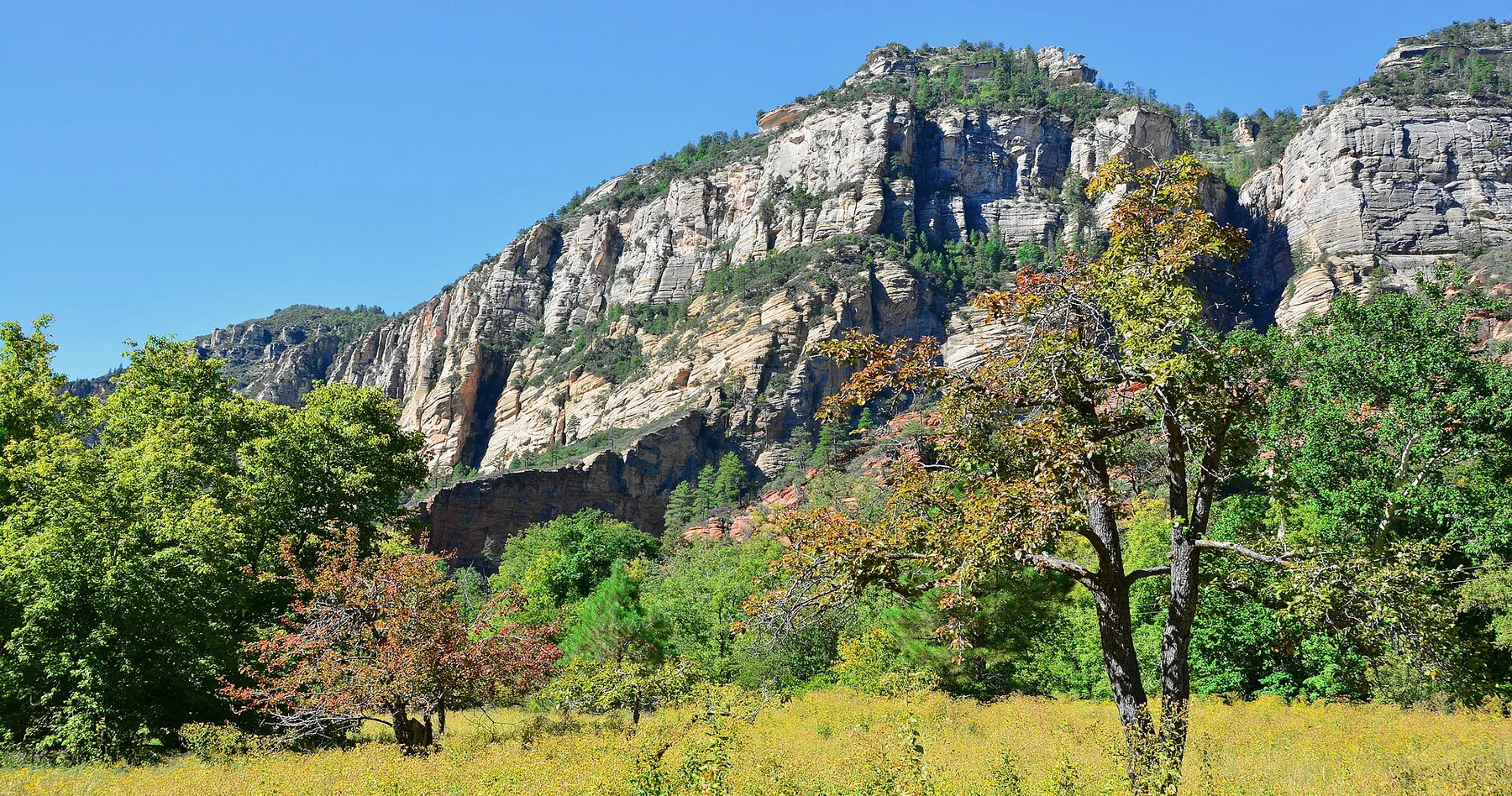
From Sedona, SR-89A climbs north through Oak Creek Canyon to Flagstaff. The Coconino National Forest describes about 15 miles (24 km) of canyon before a set of switchbacks at the northern end, a climb of about 2,200 ft (670 m), and roughly an hour's drive. The road is paved and suitable for all vehicles, but the switchbacks are not for anyone prone to carsickness. Oak Creek Vista, about a mile past the top of the switchbacks, is the overlook back down the canyon.
Two things to know:
- Parking passes. Many trailheads around Sedona need a Red Rock Pass or an America the Beautiful pass. As of October 2026, the forest lists $5 a day, $15 a week or $20 a year per vehicle at sites such as Courthouse Vista.
- Time. Kaiser's 30 extra minutes is driving only. With a stop in Sedona and a pause in the canyon, this route easily becomes a full day, which is why many travellers sleep a night in Sedona or Flagstaff before the canyon.
For what to do in Sedona itself, see our Sedona day trip.
Variations: via Williams or via Desert View
Via Williams. From Flagstaff, I-40 runs west about 44 miles (71 km) to Williams, and from there AZ-64 runs north about 60 miles (97 km), an hour according to the National Park Service, to the South Entrance. It is a little longer than US-180 but makes sense if you are staying in Williams or taking the Grand Canyon Railway, which leaves the Williams depot every morning.
Via Cameron and Desert View. From Flagstaff, US-89 runs north to Cameron, where AZ-64 turns west for 25 miles (40 km) to the East Entrance, according to the National Park Service. The East Entrance is open 24 hours unless closed by snow. You then drive the 23 miles (37 km) of Desert View Drive west to Grand Canyon Village, past the Desert View Watchtower and the eastern viewpoints, so the last hour doubles as a first look at the rim. It also lines you up for the road north to Page, Antelope Canyon and Horseshoe Bend or Monument Valley afterwards.
Without a car: Groome Transportation
Groome Transportation runs shared shuttles between Phoenix Sky Harbor and Flagstaff, and a separate route from Flagstaff to Williams, Tusayan and Grand Canyon Village. As of October 2026, its published timetables show:
| Leg | Departures | Example | Adult fare online |
|---|---|---|---|
| Phoenix Sky Harbor to Flagstaff, via Camp Verde | 13 a day, from 6:00 | 6:00 from PHX, 9:20 at the Flagstaff office | $65 |
| Flagstaff to the South Rim, via Williams and Tusayan | 3 a day (7:35, 12:35, 15:35) | 12:35 from the Flagstaff office, 14:45 at Maswik Lodge | $49 |
| South Rim to Flagstaff | 3 a day (10:00, 15:15, 18:15 from Maswik Lodge) | 15:15 from Maswik, 17:25 in Flagstaff | $49 |
Fares include a $2 fuel surcharge added in May 2026. Points to note:
- There is no direct Phoenix–Grand Canyon timetable. Groome asks travellers going from Phoenix to the Grand Canyon to call and book a connecting reservation, and all stops are by reservation only, with at least 24 hours' notice recommended.
- The fare does not include park entry. Groome lists an $8 park entry fee per passenger on top of its Grand Canyon fares. If you are not a US resident, ask how the $100 nonresident fee is handled; it also applies to visitors arriving on commercial tours.
- Adding it up: our own sum of the two online fares is $114 per adult one way, before park fees. A connecting booking may be priced differently.
- At the rim you can rely on the free park shuttles: the blue Village route and the red Hermit Road route, which replaces private cars on Hermit Road from 1 March to 30 November. The Tusayan (purple) shuttle is not running as of October 2026.
Flying closer is of limited use: according to The Points Guy, there are no scheduled commercial flights to the canyon itself, and Flagstaff's airport needs a connection through Phoenix, then a 90-minute drive.
Where to stay
The route you choose decides the base:
- Flagstaff if you drive up in the afternoon and visit the canyon the next day, or if you want a town with restaurants for several nights. It is an hour and a half from the rim.
- Sedona if you take the scenic route and want an evening among the red rocks; the canyon is then a long day trip via Oak Creek Canyon and Flagstaff.
- Williams if you plan to ride the train.
- Tusayan if you want sunrise or sunset at the rim, or if you arrive by Groome and want to be close to the park.
Our comparison of Tusayan, Williams or Flagstaff sets out the trade-offs between the canyon bases, and where to stay for the Grand Canyon and Route 66 covers all nine areas, from the gate to the Route 66 towns. If you only have one day at the rim, read the Grand Canyon in one day, and for the season, the best time to visit. Prices and conditions change: see how we review.
 Photo: Tuxyso, CC BY-SA 3.0
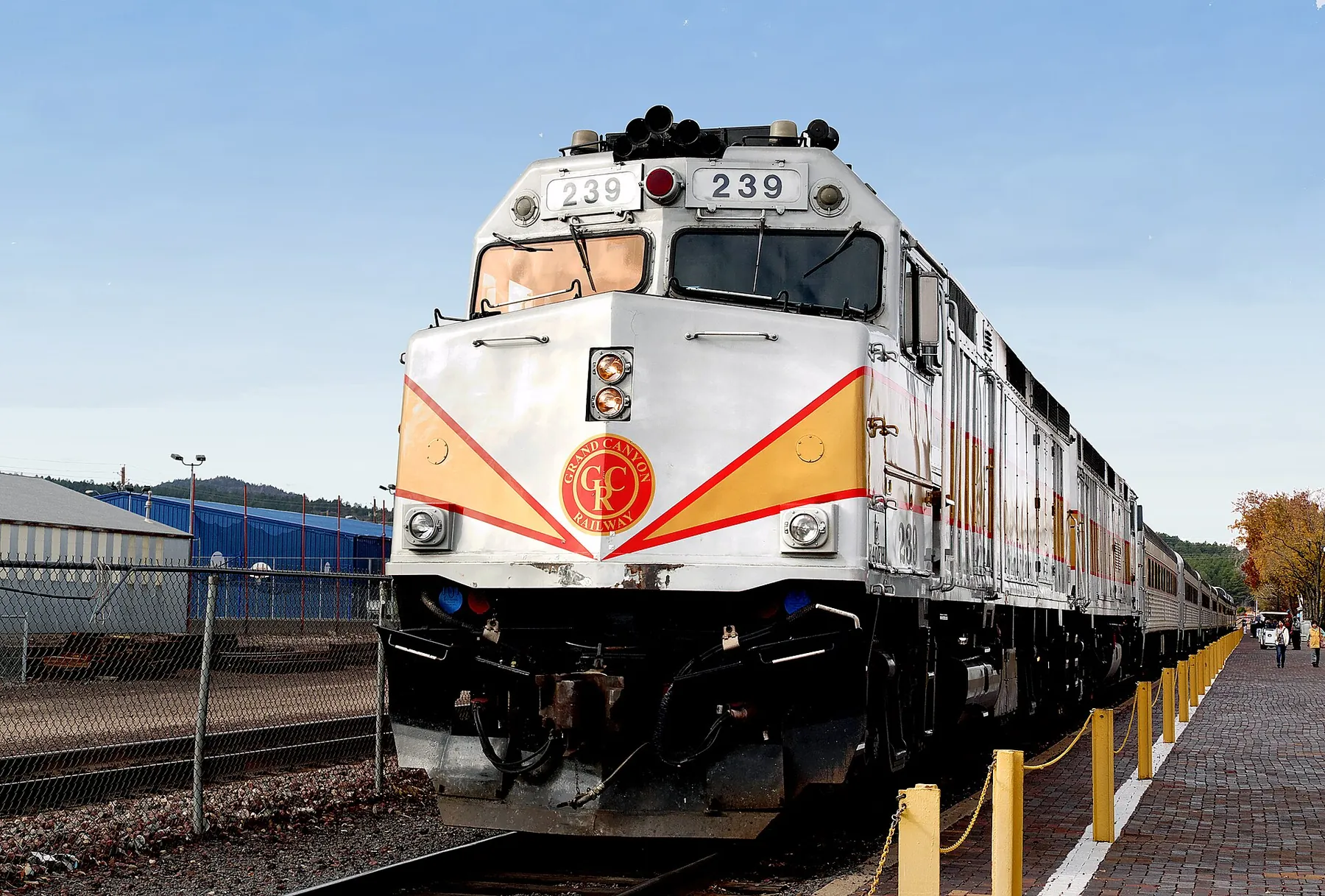 Photo: Bernard Spragg. NZ from Christchurch, New Zealand, CC0
 Photo: Mike McBey, CC BY 2.0